Baldies' Blog began originally in the UK by a 26 year old journalist with a blood cancer on a mission to inform the world about bone marrow donation.

He has since died, and I took on the cause of making cancer care more transparent for everybody.

Cancer is a disease that will touch everybody through diagnosis or affiliation: 1 in 2 men will be diagnosed and 1 in 3 woman will hear those words, "You Have Cancer."

I invite you to read how I feel along my journey and
how I am continuing to live a full life alongside my Hodgkin's lymphoma, with me controlling my cancer, not my cancer controlling me.

I hope that "Baldies' Blog" will prepare you to handle whatever life sends you, but especially if it's the message, "You Have Cancer."

Get a playlist! Standalone player Get Ringtones

Showing posts with label alternative cancer cure. Show all posts

Sunday, December 11, 2011

The Gratitude Attitude

I think I found a way to dig myself out of the irritable funk I've been in. My angry, pity party has been going on a little long. I've been complaining more than usual. Judging others. Forgetting the great things we have.


It's been over 9 weeks now since the incident that set me off. Jon had a talk with me that I was being curmudgeonly and I agreed.  It was time to pull myself up by my boot straps, get my game face on, and enjoy all I have, which has been my secret to surviving, happily, even when in the worst health imaginable, this whole time.


I call it the gratitude attitude and theorized that being thankful for friends always and the small wonders, being able to walk, stay awake a whole day, warm showers, and fresh fruit, would help me overcome the depression I'd have if I focused on the dark side: what I've lost, what we don't have, etc. etc.


So here's the plan, in article style of course, I need to find someway to get the best of both worlds:


Beat The Blues with the Gratitude Attitude 

If you’ve come to find happiness, start counting your blessings, you’ve found the right place, and now that you found help, keep counting those blessings. Science says it’s good for you.
Science is proving having a gratitude attitude: counting your blessings, looking on the bright side, and overall optimism can revitalize you.
While it may seem like common sense that positive emotions, like gratitude, beget more positive emotions, it’s only been in the last couple years that the study of happiness has seen a surge in popularity.
What’s been discovered is that gratitude is one of humanity's most powerful emotions. It makes you happier and can change your attitude about life, even if it’s dragging yourself out of a funk or helping recover from a divorce, like an emotional reset button.
Robert Emmons, Professor at the University of California, Davis, who pioneered research on the benefits of positive thinking states there are studies showing even pretending to be thankful raises levels of the neurotransmitters associated with pleasure and contentment: serotonin and dopamine, the same commonly chemically copied in  anti-depressants.                                                                                                                        Better than popping a pill, giving thanks is a potent emotion that feeds on itself, much like being victorious, creating a cycle of self-stimulated happiness. Gratitude is the gift that keeps on giving.                                                                                                             Convinced? You should be feeling better all ready with all the good news I’m bringing, but where do you start?                                                                                               1. Cut the complaints. Limit complaints to a certain amount of whines during a set timeframe. For example, give yourself one complaint each morning from getting out of bed to going to lunch. Then work towards getting the gratitude attitude. Eventually stop complaining, replacing whines with happy comments, even if the complaint is there it will be overpowered by the stronger emotion.                                                                       2. Fake It Until You Make It: Prof. Emmons states, “Live as if you feel gratitude and soon the real thing will come.”                                                                                                
3. Remind yourself of things to be grateful for. Keep a log of everything that brings you joy. One major study showed that people who wrote down what they are grateful for felt 25 percent happier after ten weeks than those who did not. They even felt better about their jobs. Another thing to be happy about: studies show logging once a week makes people happier than doing it three times as much.                                                                           
4/5. Make It Visual & Recruit the Family. Create a collage of what you are happiest for, and display it prominently. According to Emmons, a great technique for children is creating a thank-you “tree,” adding post-it note “leaves” every day to acknowledge everything good imaginable, which will also encourage good future behavior too.                     
6. Practice daily acts of gratitude.
When we think of, remember, talk about wonderful and happy moments, we feel uplifted. Keep the feeling by pausing and listing three things you are thankful for and three people to whom you are grateful. If you’re a beginner, it can be done indirectly by finding three things that could be worse.                                             
  7. Be happy in spite of unhappy events
: There are few absolute truths, and one is life isn’t fair. Good thing we can learn to be happy in spite of problems with two steps. First, after an upsetting situation, don’t react. Try to stay calm. Ignore the person. Walk away. Research. Cope however you can without blowing your top. Then, when the urge  to freak out lessens, start listing the things about the situation for which you can feel grateful, even if it’s a lesson learned.                                                                                   
8. Look at your present through the eyes of your future: Your perfect future that is, and imagine only the best, this is your life, your mind, and good creates more good. 
9.Write/Give a Heartfelt Thank You: Spread the joy in a “power thank you.” First, thank whomever specifically for what they did. Next, acknowledge the effort it. Finally, tell them what their actions mean to you. This will help others feel valued and will help you feel better about yourself and life.

Why giving thanks is good for the psyche


Gratitude Chases the Blues Away http://www.rd.com/health/gratitude-chases-blues-away/


Sunday, December 4, 2011

X's Christmas Wish Miracle


This is one of my favorite stories. Some of you loyal readers may have heard it in pieces before, but it 'tis the season to remember magic exists, wishes come true, and miracles are real.


The first time I heard the wish was in April, a full eight months before Christmas, when most children have forgotten that Santa is watching and are busy planning their April vacation.
Christmas two years ago when X made his lifesaving wish.

My Son, X, and I were sitting around on the floor, playing games, when X said seriously, "Mom, for Christmas, I am going to ask Santa to make you better."

"WHAT?!" I gasped, shocked.

“Where did this come from?!” I thought to myself, and worse, “How does my son know that he needs to ask for a miracle for me to be healthy?”

I thought we had done well hiding the fact my Hodgkin’s Lymphoma was “incurable,” and therefore, “terminal,” but as so many parents do, I had underestimated what my son understood.

"I don't want toys..." He continued, nonchalantly, looking down at the toy he was playing with, "I just want you better."

Then the tears started to well up, and my heart started to break. He was willing, at the tender age of six, to give up all the toys in the world to ask for me to be healthy.

I finally got myself together to talk to him.

"You know you don't have to wait for Christmas to ask." I told him.

"You don't?!" He yelled, looking up quickly with his big brown eyes staring, curiously, like I had the answer to the all the world’s problems.

"No, you don't have to wait,” I said, “because God is Santa's boss. He is around all the time. Santa is a helper for one night."

"So we can start writing letters NOW?!" X screamed delightfully, half asking and half demanding.

"Yes, we can write letters, and we can pray every night..." I said, trailing off, dreamily, thinking about the possibility of my own mortality, and how it was affecting my little man.

Xander cut right into my thoughts, ready to start his letter to Santa, asking for me to be healthy, and praying for me to get better.

After his April request, I constantly did the math to see if I could be healthy for Christmas.

In August, I started a round of chemotherapy that required infusions every Monday for two to three months with the guarantee that I would be sick and hospitalized during active treatment, but possibly putting me in remission for November and the holiday season.

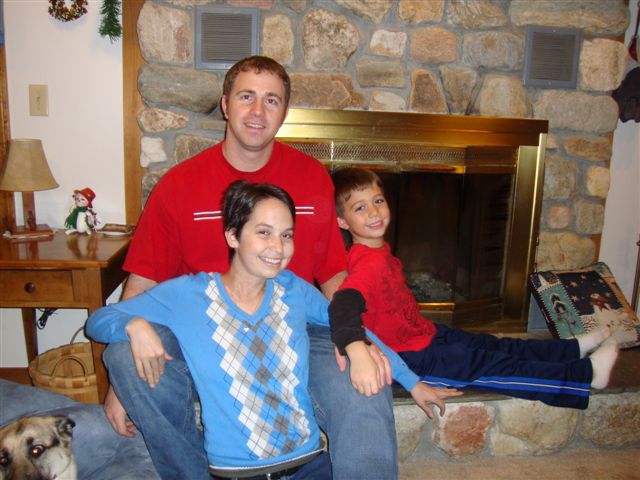
Our 2011 Family Holiday Picture.
However, instead of getting better with treatment, I got worse. My lungs began to fail in August, and I underwent multiple biopsies and surgery to diagnose the problem. By the end of November, I was undiagnosed, oxygen dependent, relying only on a third of a lung to survive, and at 26 years old, instead of a miracle, I was thinking about stopping my medications and allowing nature to take its course.

But in the back of my mind I kept thinking about X’s Christmas wish. Angrily, I wondered how God could do this to a child that put all his faith in him and Santa Claus asking for one selfless thing for Christmas.

But X never got angry. He never gave up hope. Instead, he kept reminding me that I’d be better for Christmas.

On Dec. 5th I was finally diagnosed with Bronchiolitis Obliterans, a life threatening complication of bone marrow transplantation scarier than cancer itself.

On Dec. 22, sicker than I’d ever been, I was wheeled into my Doctor’s office. Seeing the state I was in, he recommended immediate hospitalization. Instead, I burst out crying thinking I could miss my last Christmas with my family and asked for prednisone.

Steroids are a double-edged sword in cancer care. Prednisone would alleviate the inflammation causing my lung failure, but it also would almost ensure my cancer would return.

The answer was easy. I opted for steroids.

The prednisone worked like a miracle. I could eat for the first time in months. I could play games with X. We were able to do all our Christmas traditions together, and X saw that with his determined faith his Christmas wish had come true.

It’s been two years now since X made his Christmas wish. He still remembers all the letters to Santa and prayers to God he said for me to get better, but if he ever starts to forget or lose faith, I’m still here to remind him that God and Santa grant miracles, especially for Christmas.


Sunday, October 23, 2011

Creative Anxiety Coping Strategies for Those with Terminal Illness


Creative Anxiety Coping Strategies for Those with Terminal Illness
By Ryan  Rivera
Living with terminal illness is an already a difficult process as you handle all of the symptoms associated with your disease, but you have a responsibility to yourself, and your family, to enjoy every day you have left. One of the major factors that stands in your way is anxiety. It’s easy – natural, in fact – to feel anxiety when you’re diagnosed with a terminal illness.  Forty-four percent of all those diagnosed with a terminal illness experience noticeable levels of anxiety, and those numbers are skewed by those that have already sought treatment.
There’s no denying that anxiety can have a negative influence on your life. When you’re constantly worried about your health and your future, it can be difficult to enjoy the present. You need to find a way to handle your anxiety and panic attacks, whether it’s through counseling, relaxation exercises, or some type of creating anxiety coping strategy.
What Makes a Creative Coping Strategy?
Anything and everything can be a creative coping strategy. While a few examples will be illustrated below, the truth is that if it is a healthy activity that makes you feel more relaxed and content it is worthwhile. The only thing that limits you is your imagination, and your willingness to find coping ideas that you can enjoy. Examples of creative coping strategies include:
·       Art
Art can be a powerful outlet, especially when you’re dealing with chronic illness. Using your own imagination and a type of art you like (anything from painting, sketching, sculpting, etc.), you can show your affection for your friends and family, craft something that illustrates your  thoughts and concerns, and so on. In addition, you can make art pieces for those in your life that they can keep with them as memories. That can be comforting for you and the recipients of your art pieces.
·       Video Games
You may not really need to play video games – and you certainly shouldn’t play violent or thriller video games that could fuel anxiety. But video games are a great example of a fun and leisurely activity that can relax your mind. There are plenty of low-intensity, fun video games that keep your brain active and your mind off of your troubles. Video games, like comedic (non-violent/drama) television, are all useful ways to relax your mind and body.
·       Thought Poetry
There are two important things you need to do in order to cope with your daily anxiety. First, you need to keep your mind active, finding ways to not necessarily distract yourself, but to find activities you can enjoy as best you can. You also need to write down your thoughts, because our brains have a natural ability to fear forgetfulness, and when you have a terminal illness, you likely have many thoughts floating around in your mind.
Writing poetry or finding a creative way to write down your thoughts accomplishes both goals. It allows you to keep those thoughts in a permanent place, while also giving you something interesting to do. If you’re not fond of poetry, you can also try essay writing, and look for ways to turn your thoughts into something longer and more interesting.
·       Support Group Activities
Most support groups sit in a room and discuss the issues of the day. These support groups are very effective, and do provide you with a degree of social support that can reduce your overall anxiety levels. But support groups do not need to take place indoors. If you’re still feeling up to it, you can consider organizing support group games and activities, so that not only can you have a helpful ear – you also enjoy something fun and interesting.
·       Mindfulness/Relaxation Exercises
You may not always have the strength to go enjoy activities, nor the alertness to work on something creative. When you are unable to keep yourself physically and mentally active, consider performing unique calming exercises designed to relax your mind and body. There are several types of meditation, yoga, and relaxation strategies that are known to help your mind and body relax. Try deep breathing exercises, visualization, progressive muscle relaxation, autogenic training, and more – you may find one that is able to help you relax that you can continue to perform every day.
Reducing the Anxiety in Your Life
There is no doubt that being diagnosed with a terminal illness has impacted your quality of life. But you owe it to yourself, your family, and everyone around you to make sure it doesn’t affect you any further. Anxiety and panic attacks will stand in the way of enjoying every passing day, which is why it is  important you find a way to relieve your anxiety. Get counseling, go to support groups, and try to find creative and interesting ways to keep your mind and body active. It may be difficult to completely rid yourself of anxiety, but if you can decrease its strength, you can continue to enjoy as many days as possible.


About the Author: Ryan Rivera understands anxiety, and has written a great deal of information for those suffering from anxiety related to terminal illness at www.calmclinic.com>

Saturday, July 9, 2011

How to Create a complementary Health Care Arsenal!


After Five years, I'm finally creating a complementary health care arsenal. I've tried just regular cold process supplements for Hodgkins, a German regimen specifically for me (which regressed my tumor), an Anti-inflammatory and all sorts of other "diets" for health, but I've never found the combination that kept my cancer at bay and provided me with energy for a quality life. I'll take either outcome. I've hears suggestions from protein mixes and health shakes to asparagus and worms. These suggestions are often loss in the roaring tidal waves of medical suggestions and treatment, untouched.

Why has it been so long to create my arsenal and how can you help someone create their own, you may ask?
  
 First, easy, life is tough. Second, I'm about to let you know.

I've been so overwhelmed and inundated with new chemotherapy, treatments, and issues just from my primary traditional doctors that anything above and beyond could push me over the edge into the health care treatment abyss.

Being so stressed I can't add another single  element to my life without my head threatening to explode from the inside out.

But the well-meaning suggestions and options just keep presenting themselves. I'd love to try them all, but hearing them makes me want to scream. I just can't do everything myself to save my life. 

It's frustrating. I have always wanted to try these assistive techniques, but I can only handle doing them when I'm on a break from treatment, in recovery, or in remission, when I'n relatively healthy anyway.

 So all those wellmeaning, loving suggestions of green tea, a tea called whatever "canadian nurse" backwards is, power shakes, or aspragus make me mostly sad. 

I want to try them, but I can't without my strength, energy. My severe chemo brain makes altering my routines a test of my intelligence equal to physics. I don't think I'm the only patient who feels like this, but how to help is the mystery.

Here's a case where cost isn't stopping me. Time, ability, my disease and disability are the barrier. 

What I would love, in a perfect world, would be that anyone kind enough to give ideas would also come and help prepare it. Help work it into the  routine, make a large batch and freeze it so it can be available for months. Lucky, almost anything can be frozen, including bone marrow soup and asparagus puree. YUM. I can hear the squeals of excitement now.

I've been hearing about asparagus for years. I love aspragus. I bought almost a bushel of organic, local asparagus a couple years ago to try it. 

Buying it alone was a chore. I never pureed it to get 2 tbsp (or tsp.) twice daily. That's prep work. Hard work for the disabled. 

I also never was able to drive out of my way to the health food store or naturopathic pharmacy to pick up "aspargus powder." I didn't even order it over the internet.

Could I do it, yes. Is it likely. . . well, five years after its initial suggestion, I'm kind of getting around to it. The asparagus is unthawed from my freezer and in the food processor. 

This is common with patients. The feelings of being overwhelmed with your disease and traditional treatment is common across the board. 

My disease is a full time job, but that doesn't mean stop giving suggestions to help anyone, but if they don't suddenly appear two times daily with the suggested tea don't assume they don't want to try it either. 

But, please, if you have a well meaning suggestion to "cure" your loved one or better their lives, tell them, gauge their interest, and then offer a day and a time that starting it, cooking it, whatever, can be done together.

This makes it convenient; the proven primary motivator in peoples' actions. Its a twofer, people bond and a new trial is started. 

Then, if you're feeling really motivated explore patientslikeme.com and consider setting up your own personnal trial. 

I like this idea. It empowers me, making me feel like I haven't suffered in vain. If cancer overwhelms me, I'll know I left the world with more information for the future, especially if I can increase information where no other study will be done.